Collisional Ionization Equilibrium
This is the smallest of the three tests: two reactions, three species, and a fixed temperature. Because the equilibrium state has a closed-form expression, you always know the answer a correct run should converge to, which makes it a good first check for how a generated network should behave.
The network
File: networks/cie_h/react_cie_h.jet (PRIZMO format)
# collisional ionization (Cen 1992)
H + E -> H+ + E + E   []   5.85e-11*sqrt(Tgas)*exp(-157809.1/Tgas)

# recombination
H+ + E -> H           []   2.6e-13*(Tgas/1e4)**(-0.8)
There are three species: H, H+, E. The generated indices are idx_h, idx_hj, idx_e.
What it checks
Ionization balances recombination in steady state:
The electron density n_e appears on both sides and cancels, which leaves the equilibrium ionization fraction depending on temperature alone — not on density, the initial condition, or the path the system took to get there:
If a host code reaches the right x_eq, its rate coefficients, their temperature dependence, and its handling of equilibrium are all working. If it settles on the wrong constant, the rate coefficients are the place to look; if it never settles at all, the problem is more likely in the integrator.
Setup
| Quantity | Value | Note |
|---|---|---|
| Temperature | 1.5e4 K, fixed |
Do not evolve the temperature. This network has no thermal terms. |
| Total hydrogen | any, e.g. 1.0 cm⁻³ |
Sets the timescale only — see the scaling note below. |
Initial x |
1e-3 |
n_H = 0.999 n_tot, n_H+ = n_e = 1e-3 n_tot |
| End time | t · n_tot ≳ 1e15 s cm⁻³ |
Roughly two decades past equilibration. |
| Output | log-spaced, ≥ 50 points per decade | Only the final value is compared; the curve is for diagnosis. |
Seed the electrons
Collisional ionization needs an electron to get going. If you start from n_e = 0, the right-hand side is identically zero and the run never leaves its initial state. Nothing is wrong with the integrator in that case — the initial condition simply gives it nothing to do.
Density only rescales time
Both terms are second order in density, so the solution depends on t and n only through their product. This means you can pick whatever total density suits your host code and rescale the time accordingly — a run at n = 10³ cm⁻³ reaches the same state a thousand times sooner than one at n = 1 cm⁻³. The tn column in the reference table is that combined variable.
What to plot
Ionization fraction x = n_H+ / (n_H + n_H+) against t · n_tot, both axes logarithmic, with the analytic x_eq as a horizontal line.
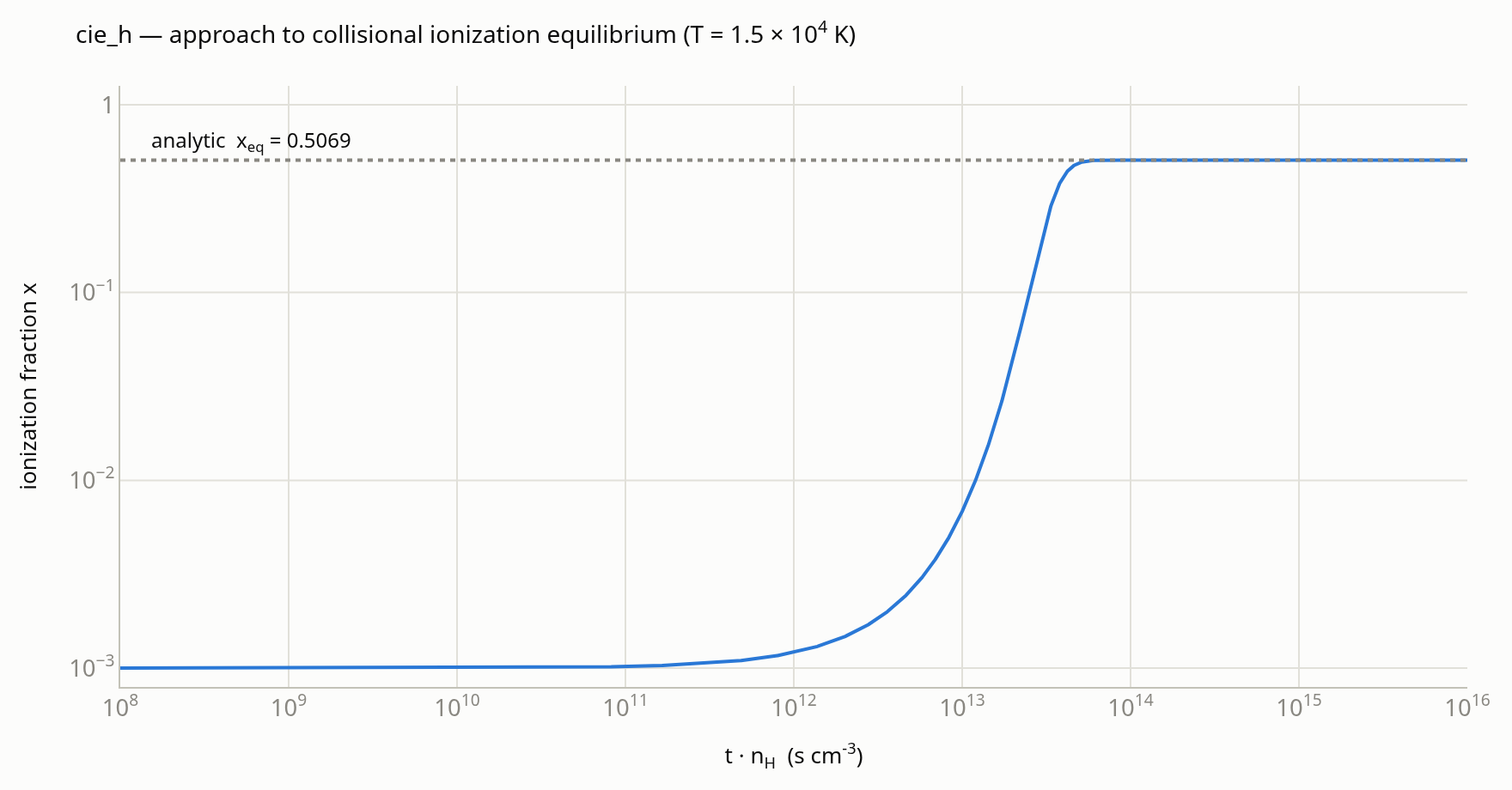
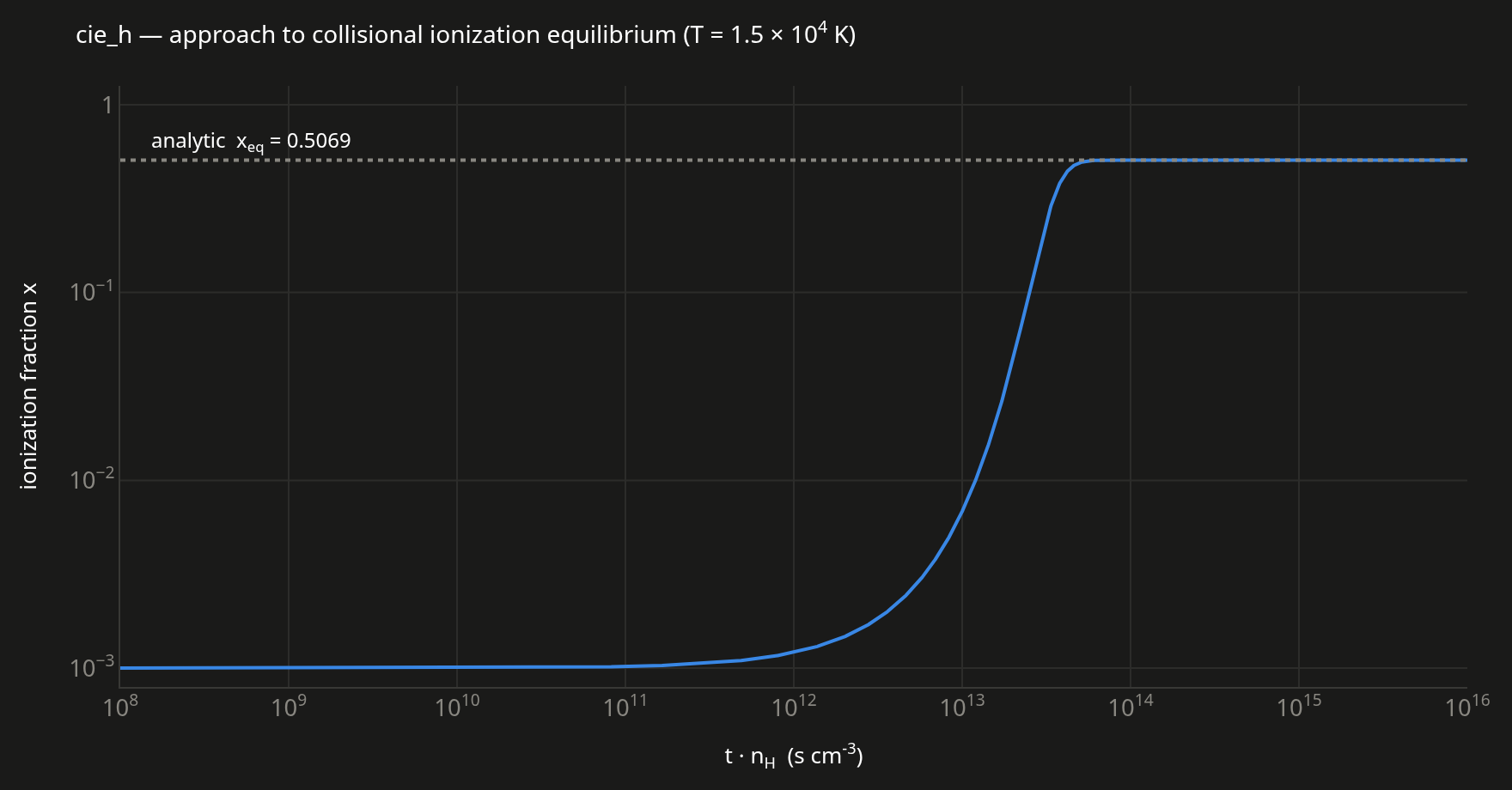
The curve stays flat at the seed value while the electron pool is still small, then turns over once ionization starts to feed itself, and finally settles onto x_eq from below.
What to expect
At T = 1.5e4 K:
If you would like to run the test at more than one temperature, here are the equilibrium values across a range:
T (K) |
k1 (cm³ s⁻¹) |
k2 (cm³ s⁻¹) |
x_eq |
|---|---|---|---|
| 8.0e3 | 1.418e-17 | 3.108e-13 | 0.000046 |
| 1.0e4 | 8.196e-16 | 2.600e-13 | 0.003142 |
| 1.5e4 | 1.933e-13 | 1.880e-13 | 0.506942 |
| 2.0e4 | 3.097e-12 | 1.493e-13 | 0.953995 |
| 3.0e4 | 5.263e-11 | 1.080e-13 | 0.997953 |
| 5.0e4 | 5.571e-10 | 7.175e-14 | 0.999871 |
| 1.0e5 | 3.818e-09 | 4.121e-14 | 0.999989 |
Suggested acceptance:
| Quantity | Threshold |
|---|---|
relative error of x_final against x_eq |
< 1e-3 |
largest departure of (n_H + n_H+) / n_tot from 1 |
< 1e-10 |
largest value of abs(n_e - n_H+) / n_tot |
< 1e-10 |
The last two check conservation of hydrogen nuclei and of charge. These follow from the structure of the right-hand side rather than from the tolerance you set, so they should hold to near round-off no matter which integrator you use.
Reference data
benchmarks/cie_h/cie_h_T1.5e4.txt — the full trajectory, integrated at rtol = 1e-12 and agreeing with x_eq to 4e-16.
| Column | Meaning |
|---|---|
t |
time (s), for n_tot = 1 |
tn |
t · n_tot (s cm⁻³) |
n_H |
atomic hydrogen (cm⁻³) |
n_Hp |
ionized hydrogen (cm⁻³) |
n_e |
electrons (cm⁻³) |
x |
n_Hp / (n_H + n_Hp) |
Unless you also ran at n_tot = 1 cm⁻³, compare against the tn column rather than t, since tn is the density-independent variable (see the scaling note above).
When it fails
| Symptom | Cause |
|---|---|
Nothing happens; x stays at its seed |
n_e = 0 initially, or the temperature never made it into the rate evaluation (T ≈ 0). |
x settles far below x_eq |
Running below 1e4 K. exp(-157809.1/T) is 2.7e-5 at 1.5e4 K and 4e-9 at 1e4 K, so the gas really does not ionize. Check the temperature before the rates. |
x settles at a wrong constant |
Rate coefficient wrong, or the temperature the network sees differs from the one you set. |
x overshoots 1 or goes negative |
Explicit or under-resolved integration, possibly masked by species clipping. |
| Nuclei conservation drifts | Renormalization enabled, or a floor/clip large enough to matter. |